Wednesday, February 23, 2022

hangover/hungover note

Yesterday, I had a hangover. Whenever I’m hungover I take a moment to think about how I got there. Because there is a bad physical feeling, like a headache, associated with a hangover, getting to the bottom of it is part of my current hangover ritual. Like maybe if I did get to the bottom of it I *could* have the wine and *not* ever feel bad ever again. But I get older every day and the bad feeling seems to be promised now in so many ways.


It’s futile so you have to move on and accept the situation. Well, you could fight it with like “hangover cures” and I certainly recommend a Coca Cola (and not drinking any coffee whatsoever) if you’re having a hard time getting your feet on the ground. But everyone has their own thing that works for them and much of that is defined by time and place. When I worked at Dove’s, I would have a paper cup with just pozole broth in it by the line, haven’t done it since. Anyway, it’s just going to be your day and you can make it bad by hating it or you can meet yourself where you are. Which is what basically everyone I talked to does.


Everyone has their little food thing but also this easy approach to themselves. Finding a little more sleep where they can or just laying down time even in public. I love to rest my head on the bus window while I’m off to somewhere that I apparently need to be. Ari says that she can usually find laughter in her day, adding levity that balances the suspended feeling. Sammie says the hangover feels like her secret and can be kind of fun. And I know what she means, there is like a strong sensation of snapping back into yourself. Drinking can feel like joining a social body, made up of however many people but the hangover can be the reconstruction of boundaries and in a very private and personal way. Time to yourself even when you have to be in public. 


We use hangover in a larger sense, which I think is one reason why I’m interested in pushing on it. The word is also used to describe “a thing that has survived from the past”. Which made me laugh so hard with how vague that is, like the potential for hangover is almost constant. The feeling after a night of crying hard reminds me of the alienation that comes with an alcohol hangover. Or something longer, a lingering unsettled feeling that you’ve done everything wrong by yourself and everyone you know. I think there’s something to be taken with the lessons of the more direct alcohol-related hangover. The slowness, quiet, sleeping, these are all useful too in approaching the things that are not as easy to pin down. Maybe I just like to think that nothing is a waste of time but I do like to think nothing is a waste of time.


La Pasta


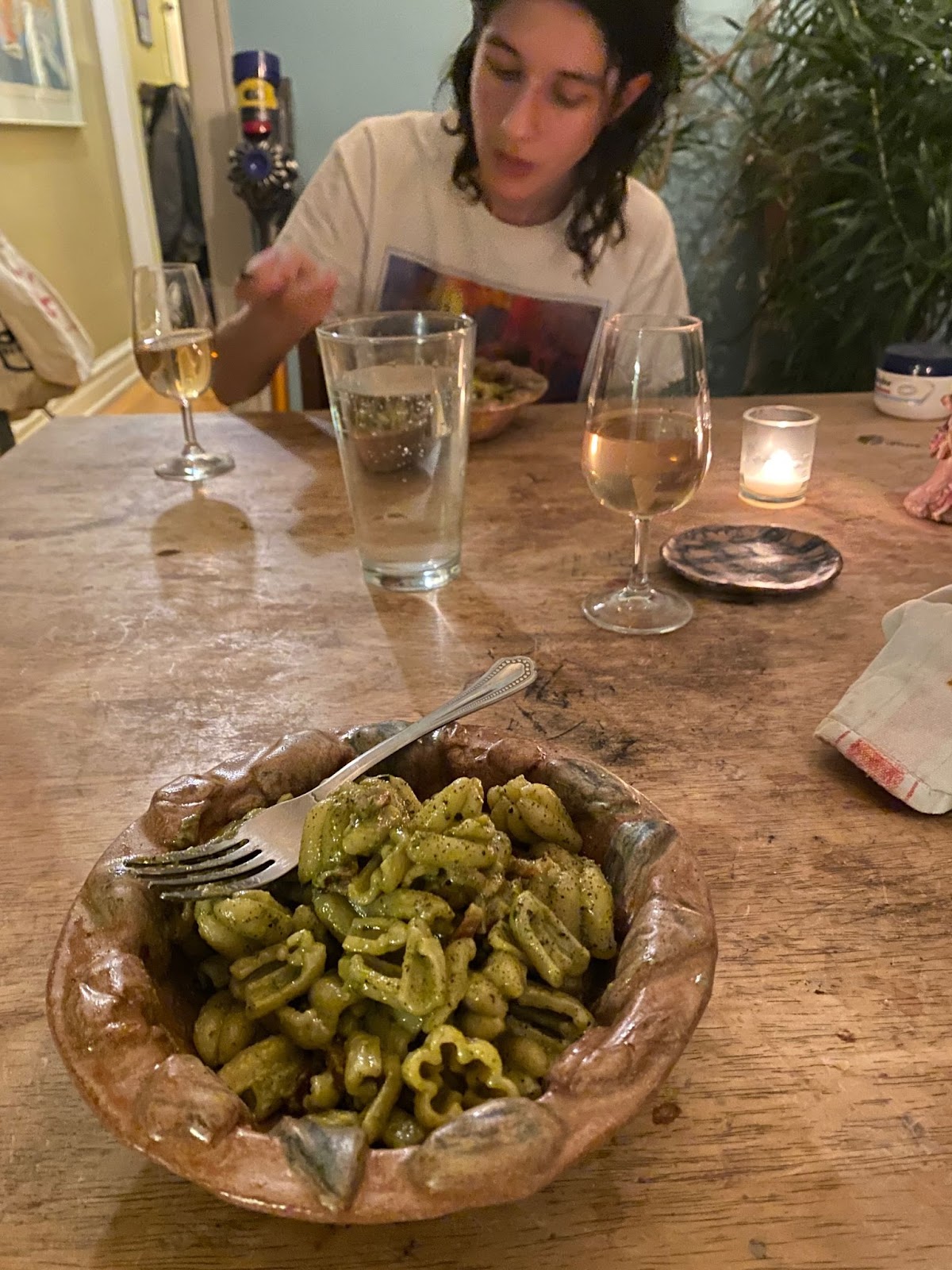
One of the most memorable dinners I’ve cooked in the past year, both for myself and the person eating it was a single dish of pasta. My friend Sofia was moving out of town and burning the candle at every end, trying to see everyone she knew and honor the quality and depth of relationship with everyone in Chicago in like a week. Or two. The amount of time that you have after reality sets in. So she was hungover for our plan to have dinner on my back porch. In the interest of making the most out of our time I put myself in her shoes and made the pasta. Rigatoni with guanciale and kale sauce, basically like a green gricia. I thought, if I were her I would want something with carbs, fat (like pork fat, cheese, and olive oil), and minerals. It was fun! And the embrace of her state by letting it guide our dinner made it memorable in a way that other dinners that have been maybe higher concept, have not been. I think it works for the life hangover too.


Kale & guanciale pasta for 2 people

This requires more kitchen equipment than pasta I make usually does. I’m sorry I think it’s for when you’re caring for a hungover person or are simply moving through life.


half pound of short pasta (or the amount you want)

1/4 cup olive oil

2 cloves of smashed garlic

bunch of kale, ribs removed

the amount of guanciale you want to eat cut into manageable cubes

parmesan

salt

pepper


  1. Boil a pot of water and add salt once it’s rolling. While you’re waiting for the water to boil heat the olive oil and garlic gently together in a pan. The garlic should become slightly golden but really you’re looking to soften it.

  2. Blanch the kale and add the leaves, garlic, and oil to a blender. Blend until smooth adding salt and pepper to taste, keeping in mind that you are combining the sauce with salty pork and cheese.

  3. Add the guanciale to the already warm pan and pasta to the already boiling water.

  4. Once the pasta is a satisfactory done-ness add it to the pan (I like to just move it from pot to pan which gets some pasta water in it too but if you’re a drainer reserve some water to add to the pan) and toss to combine. Add the kale sauce and grate the amount of parmesan cheese that you want. Mix until glossy and fully combined.

  5. Serve with more cheese and a drizzle of nicer olive oil on top.


Sofia made us a painting that we printed on some t shirts last year which are now back in stock, some size large available for Chicago delivery.


Thank you to Cub, Dario, Ari, Sammie, Riley, Sofia and Mac for talking with me about hangovers.


Wednesday, February 16, 2022

lemon: seasoning as gesture


Sour things have a high concentration of protons, the active particles with a positive electrical charge. When protons move around freely, they attach themselves quickly to nearby molecules and immediately change them. The sensation of sourness comes from protons hitting your tongue. 


There are some interesting similarities and differences in growing wine grapes and growing lemons. Unlike grapes on a vine, lemons on a tree thrive in near-constant humidity. Like grapes, they develop acidity and color when they get cold (ideally as low as fifty degrees fahrenheit, from time to time, for lemons). A major challenge in lemon farming is achieving this cold temperature without freezing - lemons, like grapes, are very sensitive to frost. 


I’m writing about lemons this week because, at some point, I stopped seasoning my cooking with acidity. We most often think of salt as seasoning, which, when correctly used, brings out the flavor of the other ingredients, rather than registering as salt on your palate. Acidity can be seasoning in the same way. Lemons were my favorite tool to achieve this. 


I learned to season food with acidity originally from my Mom, a lover of lemons, a cook with great finesse. She squeezes a little lemon on most things right before eating or serving them - from pasta to mushrooms to scrambled eggs. I was reminded of this when I worked with a chef who emphasized acidity and salinity in his cooking. This chef was particularly aggressive on seasoning - like a lot of chefs he seasoned all garnishes as well - this meant tossing your cilantro or whatever you have in lemon and oil and salt. It sounds smart but in practice usually winds up with some beaten and bruised greens propped up on the plate. It can be done well, but it’s really difficult to calibrate your hand at seasoning to such a small amount of delicate leaves. Seasoning started to feel like a force of destruction, of degradation, putting down instead of lifting up. 


Another reason I’ve moved away from lemon is my sensitivity to the fact that they don’t grow around here. I have tried, as I know many other cooks have, to deploy vinegar in its place. You can make vinegar, get it locally, and it is historically Midwestern, part of the pickling and preserving culture we have here, in part due to the Scandinavian influence. My greatest success with this has been in soup. I’m sure there’s chemistry at work I have yet to understand - heating the vinegar seems to release some of its own edge and sink it into the other flavors in the pot. You might try this with a lentil soup or tofu soup or tomato soup even. Seasoning a cooked plate with vinegar is more challenging. The fruitiness of lemon melds with other flavors more cohesively. I’ve been denying this because this knobby yellow fruit can feel so out of place in my Illinois kitchen. 


And, in place of lemon, I've been relying on wine as the seasoning for food. I’ve cooked a few dinners with so much acidity on the plate that, when you drink a wine that is also high in acidity you can’t really taste anything besides sourness. So then I framed a choice between lemons and wine, and I chose wine. 


What’s changed is I learned you can layer acidity, even as a seasoning. A few weeks ago my friends made steak au poivre, and swirled a round slice of lemon in the creamy sauce as it was finishing cooking. It added a fruitiness and lightness to the meal that was delicious. We drank Nuit d’Orage from Clos Fantine - which was also bright and brought good acidity. There was room for both with the creamy, spicy sauce, beef fat and salt. Lemon is a specific flavor to me, it is not just sourness. It has to be dosed carefully. When I season things right, they don’t taste like lemon, they taste like themselves. The au poivre tasted like black pepper and cream and brandy, but with a special quality. 


The round of lemon represented a greater sensitivity to the addition of lemon - drawing out not just juice but citrus oil and a little bitterness. A lot of attention is paid to the gesture of seasoning with salt (Salt Bae represents the vile peak of this). As overplayed as it is,  to season from a height above your food, or low to the surface makes a big difference. One of my friends who cooked the steak au poivre is a chef. His gesture of cutting this slice of citrus and gently steering it around the skillet inspired me. Seasoning is about gesture, and lemon is no exception. 


Having digested this idea, last week I made a lamb tagine. I put it in the oven and took a nap and overslept, and the tagine braised a little too long. It got a little jammy, the dried and rehydrated apricots had melted. It was delicious but rich. A generous squeeze of lemon made it much more palatable. Diced preserved lemon would have also been nice. With the tagine, I drank a bottle of Malas Uvas from La Perdida. This wine makes you salivate as soon as you smell it. It is very salty and enticing and smells very bright and sharp. In concert with the lemon juice, it livened the dinner and made the tagine feel complete. 


When I told her about this blog idea, Em lent me a book called Much Depends on Dinner by Margaret Visser. I recommend it. There’s a chapter on lemons. Visser includes an adage from the 19-century British doctor/reverend/wit Sydney Smith. It reminded me of both feeling far from where lemons grow here in Chicago, and yet of course they are easy to find and relatively affordable. “Life is a difficult thing in the country, and it requires a good deal of forethought to steer the ship, when you live twelve miles from a lemon.” I once received advice from Em that I’ll share with you – always pick up a lemon when you’re at the store, even if you don’t need it right away. You wind up wanting one more often than you realize. 


We have lots of new wines in store, particularly from a winery in Alsace called Kumpf & Meyer. This is a new winery to us, and we’ve been enjoying all the wines so far. As always, please let us know if you have any questions or curiosities - you can email us rainbowwinechi@gmail.com or DM @rainbow_wines. 


Wednesday, February 9, 2022

february beans

 The other day my mom looked at me and said something to the effect of you look like you need a Coke (and offered me a tiny can of Coke). Which was her way of saying I looked tired.


The other other day in the car Cub and I were talking about dining for health, not so intentionally but we usually talk about dining for pleasure so it stuck with me. While these things aren’t at odds necessarily I take it a bit like Luce Giard, sailing between “the Lake of Fondness and the Ocean of Reason” in a third, unnamed body of water where the two mingle. Potentially that body of water is made of bean pot liquor. The rich health elixir of olive oil, starch, and whatever else you ended up putting in the pot. 


So with this Coke I had a bowl of beans and it wasn’t magic but it did feel like a solution. It was the last of a pot I had made in mid-January, I’ve made two pots since actually. All different beans. These were cranberries that I stuck in the freezer. The next pot was for a friend, not that they asked for beans. Again, beans feel like a solution  to the fact that it’s February and nothing is fresh in Chicago, to the fact that it’s too cold to walk to the store, to my desire to cook something lovingly while working two jobs.


To cook beans I put olive oil in a pot followed by an onion and celery. You could put carrots too but I don’t. As those loosen up I add spices and dried herbs. Like white pepper, coriander, oregano, thyme, rosemary, crushed red pepper like for pizza. Sometimes a charred lemon goes in, colatura di alici/fish sauce or white wine, I like a parmesan rind from time to time. Twice as many greens as beans or some prosciutto ends. Those things I don’t always have. But it’s nice because it helps you learn to pay more attention to what you do have, how it shapes its companions in the pot/they shape it back. Because you can also make beans with just beans and water, if you want. Anyway, you put in the beans and water to cover, the beans are soaked if you have time. Also I salt them while they’re cooking. I've never really noticed a difference. They stay on the stovetop until they’re finished because I like different textures but if you like a more even cook in the oven that’s fine. I usually also do something else during this time.


While the act of cooking beans is perhaps a solution, the finished pot also feels like a celebration. The pot stretches so far for one or two people especially, it’s like you’ve cooked to never cook again. Trish, who lives in a region known for their beans, eats them many times a week but also will take a glass of the cooking liquid next to her water and wine with dinner. I think about her when I stand over the stove drinking the pot liquor. The beans themselves can then become pasta e fagioli, beans on toast, bean & clam soup, a condiment for another soup like cabbage soup once the pork has gone.


My favorite, the one that takes a little more effort and the outcome of the third pot of beans, is an homage to the antipasti plate at one of America’s great restaurants, Ops. At Ops they offer a plate of white beans, marinated beets, and feta with a sidecar of bread as a prelude to pizza. A recent small survey of people (women) suggests that this itself is actually the perfect meal. Especially with the addition of some greens cooked in Cub’s lid style. Freshness this time of year is found in wines and the cookedness of this meal plays into that nicely. The ones that I am craving have a lot of acidity, density and earthliness that match the dish, wines that you can feel in not just your mouth and head but the rest of your body too; Malas Uvas from La Perdida, A Flor de Piel from Vigna Flor, and Bessons from Toni Sanchez Ortiz. Or the explosive pet nat Waterfly from Celler Ca Foracaime or perennially in the shop favorite Coule de Source from Jerome Lambert. I think the Chenin thing has to do with Anjou native Rabelais and Pantagruel infected daydreams.


Back to the pot, you can freeze what you can’t eat now (Georgian winemaker Ének Peterson just captioned an Instagram “freezers are amazing”, so true). And pick this back up when you are down again. Baby steps back with some easy food and some wine.


Wednesday, February 2, 2022

p'tit poussot & pizza, wist, whim and whimsy


     The past few weeks, I haven't been connecting with wine as much as I usually do. Things just haven’t been clicking a lot, wine wise. Sometimes in our circle of natural wine loving friends we say, ‘wine is tasting really good right now,’ because it will feel over the span of a few days or weeks that all wine everywhere in town is tasting delicious. I went for about two weeks of missing this feeling and sought to change it.  

Last week I had a night to myself and ordered pizza from Jimmy’s Pizza Cafe, which I recommend for a new york slice style. I wasn’t sure about opening P’tit Poussot, a Chardonnay from one of Alice’s own vines. it’s on the spendier side for one of our wines, i didn’t think i’d finish the whole bottle to myself, and it doesn’t register for me as a ‘pizza wine,’ i.e. it's not sangiovese. On the other hand, it’s a winery that really gets at me, and it’s a wine that isn’t very high in alcohol, so I felt like if I did drink a lot of the wine, it would be less detrimental to the next morning. Now, in recounting this for the blog, I also remember drinking a 2014 bottle of Corvee de Trousseau from Octavin that was 9% alcohol by myself on a Monday night at Red & White, the wine shop where I used to work, and having a great time. I poured some for a person who came in to the shop and they also bought a bottle, even though it wasn’t what they had planned to get. It was spendy then too, and I felt my whim was rewarded. It was an interesting, engaging and perfect wine to drink alone, you didn’t feel alone but rather in the company of this wine as it shifted in your glass. It was a chatty wine, and we had a nice conversation.      

I have been enjoying the wines for about seven years or so. I fell for her wines pretty hard. They showed me something unique about wine at a certain point in my career when I was ready to discover more. After drinking them for this time, and generally being into wines of nature, I have disabused myself of the notion of having an expectation of them. My expectation is, this is going to be different. 

Alice Bouvot is a vanguard vigneronne working in the Jura mountains, in the capital of this beloved region, a town called Arbois. It’s easy to be obsessed with Alice. I’ve never met her but she seems passionate, intelligent with an amazing sense of whimsy based on how she labels and calls her wines, many illustrated with gnomes. My impressions are based on second-hand stories, and from this one video on her american importer's website, Zev Rovine Selections. She seems to be popular since she has a lot of winemaker friends to harvest fruit with when her vintage is low-yielding, as it has unfortunately been a lot in recent years. She travels to the languedoc, to Alsace, to Beaujolais to harvest fruit with these colleagues that she brings back with her to vinify at her winery. 

Alice's wines are beautiful and totally inimitable. She is adept at many techniques of winemaking, displaying skill with carbonic maceration, petillant naturel, direct press and macerated wines. One thing that helped me understand her project is when I called up Zev Rovine to talk about the wines he had started importing from Domaine de la Pinte. Pinte is a more traditional Jura winery. It is much, much bigger, an organic farming enterprise in comparison to Alice's small shop. Zev was describing Domaine de la Pinte, and I asked, so how would you compare these wines to Alice Bouvot’s, and he didn’t really know where to start. Something interesting came up which is - that he said Alice doesn’t like very extracted wines, her emphasis is on brief macerations and concise fermentations. She also harvests on the earlier side, she’s not going for big ripeness. The wines are ready to age relatively quickly. I thought about how especially true this is in comparison to Domaine de La Pinte, whose craft is focused more on the structure of tannin and acidity. Alice seems to be  working with something beyond the traditional expression of wine (of bitterness and brightness as the building blocks of weight and texture). Her building blocks are maybe not blocks at all, she seems to find ways in, out and through grapes that render you wordless. I probably have to go visit the winery to understand how she achieves the range of textures she does without leaning on ripeness and tannin, I’m sure it’s in how she does everything, from how she moves the juice to when she bottles, and more.  

Sometimes I forget how important it is to listen to a lot of music at a loud volume, then I listen to music loud and find it so much better. The wine analogy for me is that sometimes I forget to drink the wine in my glass. When I am cooking I get my hands dirty and get busy and distracted, then it’s a rush to get food to the table, then I am hungry and just want to eat, and while eating I sip some wine but don’t really just drink. or don’t really get into the wine somehow, I’m too busy unpacking what I cooked, considering it from several angles. 

Before I had my pizza I made sure to drink a glass of this wine. easy to do, as it was seriously delicious. Sometimes it’s nice to get a little drunk. To me, alcohol is an important part of a wine’s expression. 

In other vintages P’tit Poussot has been so light and even lower in alcohol that you can’t quite catch it, trying to grab a fish from a stream. The last bottle I'd had was also lightly fizzy, floating up and away, even more elusive. I remember the wine being closer to green in color. I thought of Australian Semillon or some Riesling or something. 

I was a little surprised and delighted at how this vintage of P’tit Poussot was. It feels airy yet also grounded. It turned out to be a perfectly great drink with pizza, it had enough body and acidity. Most of all, while not an intuitive pairing, what makes it work is that relationship of time and energy. I had space to be with the wine because someone else made the pizza. 

So I recommend you try some pizza and P’tit Poussot. Or just drink P’tit Poussot, or any wine. I hope that, for you as it is for me, spending some time trying to dialogue with a wine will make for a nice night. We have an embarrassment of riches in terms of interesting and tasty things in the shop, including a rainbow of bottles from a new winery, Vigna Flor, from the Veneto, in Italy. Lots to explore and discover. As always, please let us know if you have any questions or curiosities, you can email rainbowwinechi@gmail.com or dm @rainbowwine. Cheers. 


Tuesday, January 25, 2022

flavors saved my life 3


I found this old notebook the other morning after spending the evening with my friend Kat, who I love that I don’t always get the time with. It has notes, quotes, or snippets rather, from Laura Marks’ book The Skin of the Film: Intercultural Cinema, Embodiment, and the Senses. Which I bought after graduating from school. We had read a chapter in the best class I ever took and I wanted to keep it with me. I don’t know where the book is, I think my friend used it once to prop up my air conditioner, so I just have these notes to riff on.


In the book Marks writes about an idea of hers, her most influential, called haptic visuality. She describes it as “a way of looking that does not isolate, master, or seek to identify what is beheld, but instead merges with it.” My notes help create a sense of what that image looks like: “close up -> soft fuzzy, familiar, does not require the close scrutiny of optical visuality.*”


Sight can be an ok analogy to taste if you can accept the idea that all senses are actually touch senses. I feel I came to this on my own in my life, inspired by this reading and some other things, but it’s something other people use too. Atsunori Satake, who I interviewed in May of last year also orients his work in this way. And once when I brought it up with a colleague who I thought might have something more to say about wine/touch/taste: not only does wine touch your tongue to perceive the heady taste response, it also goes inside of your body and touches you in a way that is harder to understand. In your throat and in your stomach and keeps going. He told me I should have a drink with his other friend, the winemaker Laureano Serres. And I hope to do that someday because we haven’t talked about it since.


Drinking something can be a close up. Seeing wine with your eye is limited. Seeing with your tongue is a possibility, but in the abstraction of sight you have a choice. Because the tongue is not a literal eye, the repeated experience of tasting shapes your relationship to your tongue and your perception of information. If a flavor is a signifier of a fact like a technique, terroir, variety, vintage, personality, or more likely the combination of all/some of those, how are you seeing them? Or does that alchemy produce something else to look at estranged from those facts? And then still what about the feelings that lack the immediacy or history of language, the touched gut and the gullet? We are also smelling. I tried to talk about it with a different winemaker who I respect, and he did not like the idea that all senses can be joined by touch. The senses are discreet, taste is taste and touch is touch. Which is useful because while I have a different perspective I think these approaches to understanding information derived from taste rely on each other. My only “take” is that there is perhaps an overemphasis on the approach that seems to model itself on optical visuality and the notion of achievement in this field is hinged on it.


Marks also references the writer Vivian Sobchack who calls this mode of seeing (for me a mode of tasting, for both of us a mode of touch) a volitional and deliberate vision. This is a choice, it can be considered an exercise and it doesn't always come easily. Practicing this both I and the object of my vision constitute each other, considered in this context intersubjective eroticism. The erotic lives in the merging between self and object in a way that shifts our power dynamic with what we are in relation to. Talking to a friend the other day he pulled a quote from Atsunori Satake that begins to help shape this practice:

“[My] philosophy of combining wine and vessels starts with the idea that ‘I am in the position of wine.’ The traditional method of serving wine has been "how people can enjoy wine". My philosophy is ‘how wine can enjoy’. If there is a correct answer to the taste of wine, I feel that it is there.

I think with something you consume it’s actually more direct than the film image, or like imagining how you consume images. Though you choose this I think sometimes, maybe with this in the back of your mind or with a bit of practice/the right “look”, the wine forces you to privilege the sensual knowledge over the intellectual. To really try to feel it all the way down, which maybe looks like letting go of the mouth entirely, what happens with the faculty of taste and the ability to speak to it. When you are left with, “not just the taste but also the feeling”.


To be honest, I find that notebook a lot. There are other things in it like old Cellar Door menu meeting notes, ideas for clay, and sketches for a tattoo I gave that says “GODBLESS” (for a long time on the arm it looked like “GOOBLESS”). In the past I’ve gently mourned the distance between my mind and that writing, the ability to read something like that also comes with practice. But the preface to it, the night with this Bugey Pinot Noir that neither of us (wine people) claimed to understand, was practice enough to connect. 


*Optical visuality is less intimate, a “distant view of complete subject associated with Renaissance perspective. Renders the image as a figure distinct from the ground. Viewers receive it from a distance.” This is commonly considered “being objective”.


Wednesday, January 19, 2022

the salad of winter, it's buttery, steamed greens

 The other title we considered for this blog is “Must love lids.” 


Frying greens


Roughage entered my life hard and heavy while cooking and eating in food cooperatives in college. I learned one way to prepare it, usually kale or swiss chard, which was to feed around 100 people at a time  - wash it, remove leaves from stalks, chop it. Heat some oil in a giant wok. Toss all your greens in there all at once, salt it, toss it with two huge spoons, keep tossing, reaching down into the wok like you’re scooping up a big pile of laundry from off the ground. There is some steaming involved in this method because the greens were always still wet from their wash. 


After college my husband’s Mom bought us tickets to a cooking class in Brooklyn at Sunday Suppers. The class consisted of cooking a dinner together of seared and braised chicken thighs. We made kale to go with it. The method taught was to fry the kale. Heat a cast iron skillet, make it really hot, use a high heat neutral oil like canola in the pan. Put just a few greens at a time in, season heavily with salt, often. Don’t fuss with the greens a lot, let them crisp and pop and brown before you turn them just once. Again, you have to work in really small batches for this. Those greens were delicious but still really chewy, kind of sinewy. Over the years of repeating that method faithfully, they seemed to get more and more sinewy and less good. 


A Simple method 


Before this year, I experimented just a little. I’ve tried and failed at pan roasting (I don’t know what I was thinking but I wasn’t following a recipe. There’s probably a good way to do this, if you know please tell me). I’ve also occasionally sauteed in olive oil and white wine, again over medium-high heat in a skillet - the result is usually high in acid, usually too much. For a boiled dinner I once boiled the kale, too, which was interesting, and easy to chew, but a little zapped of flavor, and really very wet. 


Then this winter I came across a recipe in Canal House Cooks Every Day by Christopher Hirsheimer and Melissa Hamilton. It is not singled out as its own recipe as much as a method included as part of a dinner of steak and french fries, and it is referred to as ‘buttered spinach.’


This recipe has been revolutionary for me because it allows you to walk away from the pan while getting the rest of your dinner ready. The silky, supple greens may not be as dynamic in texture as some hot-fried leaves, but I really don’t find this an issue. 


I was skeptical at first because I never use a lid. I was taught in cookery school to never use a lid with any hearty greens because the condensation on the inside of the lid can mute the color of the greens and turn them brown. This has not been my experience with this recipe. I love lids now. They give you control and keep things tidy. 


Salad time 


I come from a family that eats salad at the end of every dinner. I find it a beautiful marker of the passage of the meal, when it’s salad time. It is a decision that is made as a group, when to commence with the salad course. Actually now that I write that I’m realizing my Mom votes for us all. Usually my Dad is talking to, quite possibly arguing, with my sister or me, and so whichever one of us is less engaged in the dialogue, turns to my Mom and mouths, “salad?” soundlessly, propping up the bowl a little to make clear the pantomime, and she either nods yes or shakes her head no) Sometimes the pause for the simple survey presents an opportunity to raise a new topic for discussion, and to open another bottle of wine. Salad means we are all sitting here for a little while longer, let’s settle in again, but maybe we talked enough about (pick any hot topic) tonight. 


I have mostly continued my family’s salad after dinner always tradition, until recently.  In the summer I always make at least a little salad, but in the winter I’m finding a lack of energy to chop up a bunch of cold vegetables from the fridge and make a fresh vinaigrette for them. My hands are already cold, I don’t need to be peeling a 39 degree cucumber. 


I got to enjoying these greens so much that now I just make a big pile of them to eat like salad at the end of the meal. For instance, if I made pasta for dinner in the past there would be salad as a green veg but it’s very nice to have some hot steamed broccoli rabe in olive oil as an alternative. 


Greens 

Adapted from Canal House Cooks Every Day 


As suggested by Canal House, the greens are wonderful with a chewy steak. Notably, I’ve had them with seared short ribs and polenta, as well as lamb loin chops with potato puree. They are also wonderful with some nicely cooked beans, which have their own chew and pop. 


3 tablespoons butter 

2 tablespoons water 

½ pound washed, de-stemmed and chopped hearty greens, like spinach, kale, swiss chard, escarole or Broccoli rabe*


Melt the butter in a large pot over medium heat. Add the greens by handfuls, seasoning with salt, and turning with tongs to coat with butter as it wilts. Once all the greens are in, add the water, cover, and reduce heat to medium-low. Cook until the greens are very silky but not disintegrating, 8 - 12 min. (For those more fibrous greens, like kale, rabe, chard, lean towards the longer end of the cooking time. For escarole and spinach, make it more brief).  Remove from the heat. Keep covered until you are ready to serve. 


*If using escarole or broccoli rabe I prefer to substitute olive oil for the butter and to toss in a halved clove of garlic. 


And to drink:


We recently received a number of fuller-bodied red wines that can match the richness, tannin  and iron-density of something like spinach. In particular the Fior di Rosso from Nino Barraco works harmoniously here. 


We also have a restock on the Sonoma Mountain Winery Merlot, a new vintage of Rosso di Gaetano from Le Coste, an enigmatic and beautiful Tuscan white wine from Ranchelle called Roccolina, as well as a new red from Caleb Leisure. Lots of inspiring things to drink that work well with wintery dinners. 


escarole with cotechino, lentils and potatoes

chard with lamb loin chops 

Wednesday, January 12, 2022

mostly here (Chicago), a little there (NY/France)

I have just gotten another cookbook at the suggestion of my friend Sammie, one she has been talking about for months. The book is Pork & Sons by Stephané Reynaud, a French chef who comes from a family of butchers who have made their home in the Ardèche. I think she first came across it in a rented house last summer. This most recent mention clicked and I placed an order for the book, I use pork in our house more than most other meats, it seemed worth the exploration.


Flipping through a new cookbook is still fun for me, in a way that combing the internet is not. The finite possibilities, the fact that it’s someone’s world representing, in a way, the past few years of their life at least. Some great cookbooks are the sum of the author’s entire experience in the kitchen. Which is beautiful and can be alienating as much as it stokes curiosity. For instance, Stephané’s experience is in France and he tends to reference a lot of sausages unavailable at any butcher counter in the city. You look at them, think someday, and turn the page to something you can make and in this instance, it was a cabbage soup.


It’s actually a cabbage soup with pork belly, his soupe aux choux. I don’t usually cook with pork belly, for me it’s a casualty of the early 2000s New American restaurant obsession with the cut. Which isn’t fair and made this recipe all the more compelling.


Earlier, I was reading from a book quoting John Cage, “It is only irritating to think one would like to be somewhere else. Here we are now.” He was not talking about Chicago winter and liking to be somewhere else holds a number of other options (emotionally, your social position, career, whatever) but maybe it was all of those things that drove me to make this cabbage soup. To need to make the soup. Cooking can be transportive but it can also make you feel like you are really where you are. I’m not sure where the ingredients I used came from, but I think you could source most of them locally. Potatoes, cabbage, onions, and celery root all store for a long time. Could get you through a winter, even though we don’t have to think about that at the grocer I think it is why they loan themselves to my “feeling”, which then becomes a craving.


I shared with Sammie my excitement and she immediately shared in it. We both set out to get the ingredients, to cook in different cities and share our process. Like recipe penpals. I had a headstart and already was fiddling with the guidelines, salting and spicing my pork a day early. The day we were set to cook was an aimless one for me, full for her. I started around 1 even though it was for dinner. With the head start, I chose to add to the cooking time in order to get the pork tender and bring extra harmony to the four ingredients in my pot. What’s nice is you don’t have to, I tried the pork after the recommended hour and it’s enjoyable in its chewier state and the soup itself eats a bit lighter, less intense as the belly keeps more of its characteristics to itself.


To serve I baked a little loaf of soda bread and made a salad of celery root. And already had opened the macerated Gewurztraminer from Jean Ginglinger so served that alongside. It was the perfect pairing because picking this wine out of the box I wanted it like I wanted this soup. I sent pictures to Sammie, she had a whole wheat boule and a radicchio salad with celery root. We have similar red enamel pots. It feels like we’re in class, completing an assignment, exploring the meaning of the soup. How to bring it to Chicago or New York. I do recommend this soup but mostly I recommend a cooking penpal, and you could start here.


Cabbage Soup inspired by, but different from Stephané Reynaud

You don't really have to season the pork ahead of time. This feeds like six people or, is enough to give some away in a to go container, share with one person at your house, and then for lunch for the next 3 days. I recommend this with some bread and a root vegetable salad.


Olive oil

1 cabbage (white/green), cored and shredded

¼ cup white wine

3 large potatoes, peeled and coarsely chopped

2 onions, coarsely chopped

Small to medium slab of pork belly (honestly depends how meaty you want your soup to be)

Fresh grated nutmeg

White pepper

Clove (optional)

Salt


  1. The day before put salt, white pepper, and nutmeg over your slab of pork belly. Stud with cloves if you’d like. Loosely cover and leave in the fridge until you are ready to cook.

  2. Take out your pork belly, remove cloves if using and cut into thick slices.

  3. Heat 5 tbsps of olive oil in a big pot, large enough to fit the cabbage, onions, and potatoes. Add cabbage and cook until softened (not browned).

  4. Add white wine, potatoes, onions, white pepper, salt and nutmeg. Cover with water.

  5. Add pork slices and bring to a boil, lower the heat and simmer until you are satisfied with the flavor and texture. At least one hour.

  6. Remove the meat with a slotted spoon and set aside.

  7. Transfer soup to a blender and blend until smooth.

  8. When ready to serve make sure the soup is the temperature you like, the pork belly can appear on the side or in the soup up to you.


Fresh stuff in the shop for tomorrow and cat calendars are IN STOCK! For the third year running Cub's put together 12 months of cats and natural wine. Something I always look forward to. See you later this week.